

 LinkedIn
The monthly bill: about $3,000 to $4,700
A $29 monitoring subscription is not an in-house AI visibility program. It is a subscription. Once someone has to research prompts, read the results, rewrite pages, pursue citations, and get technical fixes shipped, a realistic small-business program costs about $3,000 to $4,700 a month. A more aggressive program can run roughly $6,200 to $9,500.
The software is a small line on that bill, though not the less-than-10% sliver a neat sales pitch might suggest. In the working example below, monitoring and crawling tools cost $519 of a roughly $3,833 monthly program. Most of the money goes to people doing the work and a developer implementing what they find. Price only the dashboard, and you hide the rest inside calendars and a backlog.
I use a $47.17 loaded hourly rate for a marketing specialist, which includes costs beyond a $78,760 base salary, and budget developer time at $100 an hour. That developer rate is an assumption for this breakdown, not a vendor quote. Your bill will move with your staff costs, content volume, technical condition, and the hours you can actually assign.
| Recurring line item | Listed vendor cost / month | Internal work / month | Monthly total | Basis / source |
|---|---|---|---|---|
| Multi-engine prompt monitoring | $399 | — | $399 | Monitoring plan comparison; pricing comparison |
| Technical crawler | $120 | — | $120 | Crawler pricing comparison |
| Prompt research and upkeep | $0 | 8–12 marketer hours | $377–$566 | Hours budgeted at $47.17/hour |
| Report analysis and task triage | $0 | 6–10 marketer hours | $283–$472 | Hours budgeted at $47.17/hour |
| Content rewrites and answer assets | $300–$600 freelance | 12–20 marketer hours | $866–$1,543 | Content production benchmarks, plus internal hours |
| Crawl, rendering, and schema fixes | $0 | 4–8 developer hours | $400–$800 | Hours budgeted at $100/hour |
| Off-site citation outreach | $0 | 12–16 marketer hours | $566–$755 | Internal-hours alternative to agency PR pricing |
| Total recurring program | $819–$1,119 | $2,192–$3,536 | $3,011–$4,655 | Ranges rounded by line item; about $3,833 at the working midpoint |
Those are recurring costs, not the first-month invoice. Building the initial prompt set takes an estimated 15–20 marketer hours ($708–$943). Allow another two hours for monitoring setup (about $94) and three for crawler setup (about $141). If setup and regular monthly work both land in month one, that adds roughly $943–$1,179 to the recurring bill. No one should tuck those hours into a footnote and call the first month cheap.
Lines 1 and 2: the software invoice is only the entry fee
When a vendor leads with $29 a month, read the limits before building a budget around it. Otterly AI’s Lite tier is listed at $29, with 15 tracked prompts. That may tell you whether the category is worth watching. It does not give a business with multiple products, locations, or buyer questions much room to investigate.
Profound’s advertised $99 Starter tier has a different catch: the pricing comparison says it monitors ChatGPT but omits Perplexity and Google AI Overviews, with a 50-prompt cap and no search-volume metrics or CSV exports. The multi-engine Growth tier is listed at $399 to $499 a month. In the table, I use $399. A starter price is not the price of the coverage you intend to use.

Technical auditing is the second invoice. A Screaming Frog SEO Spider desktop license is listed at £149 to £259 a year, roughly $200 to $280 annually. Scheduled crawls still need a machine and someone to manage the workflow. The cloud-crawler option used in this budget adds about £95, or $120, a month. Either way, the tool reports what it finds; it does not rewrite a page or persuade an engineer to fix rendering. For this program, software starts at $519 a month before anyone acts on a finding.
Line 3: prompt tracking takes research, then upkeep
Traditional keyword lists offer a tempting shortcut: pick your commercial terms and watch the rankings. Buyer prompts are messier. Someone shopping for commercial HVAC maintenance might ask about emergency chiller repairs for a particular kind of building, not type the tidy phrase on your service page. If you monitor only the tidy phrase, you can get a reassuring chart about the wrong question.
I would budget 15–20 hours once to build an initial set of 50–100 high-intent prompt variants. That means reviewing customer questions and sales-call language, then checking how competitors appear in relevant answers. It is the one-off research cost above, not another monthly subscription.
After that, allow 8–12 hours a month, or $377–$566 at the loaded rate, to prune stale queries, add useful variations, and check whether a change in citations reflects something worth acting on. The prompt set does not need ceremonial weekly reinvention. It does need an owner. Otherwise, you can spend $399 every month watching questions that no longer help you decide what to publish or fix.
Line 4: someone has to read the report
Picture the Monday export: two more citations on ChatGPT, three fewer on Perplexity, and a missing result for a valuable commercial question. A red badge tells you where to look. It does not tell you whether the answer needs a clearer definition, a better comparison page, a technical repair, or an external source that corroborates your claims.
That diagnosis is work. Someone has to inspect the prompts, read the cited pages, decide which differences matter, and turn a finding into an editorial or engineering ticket with an owner. I budget 6–10 marketer hours a month, or $283–$472, for report analysis and triage across a 50-to-100-prompt set.
This is the part most likely to disappear under the label reporting. I have seen enough dashboards become a weekly ritual to distrust a plan that stops at exporting one. If the report produces no decision, the monitoring fee bought a meeting.
Line 5: content costs more than the draft fee
A cited answer needs a page that actually answers the question. Sometimes that means restructuring an existing landing page so a buyer can find the comparison, limitation, or price explanation without excavating three paragraphs of positioning. Sometimes it means publishing a new, prompt-matched answer asset. Neither happens when the monitoring tool says content opportunity.
The content production benchmarks cited here put a rewrite at 4–8 hours of internal work and a new technical comparison piece at $400–$700 once writing and internal handling are considered. For the monthly ledger, I budget two rewrites and one new answer asset: $300–$600 in freelance production, plus 12–20 staff hours for editing, validation, rewriting, and publishing. That is $866–$1,543 a month. The freelance invoice is visible. The time spent making the work accurate and usable usually is not.
A cheaper cadence is possible. It also means fewer pages get improved. Keep the tradeoff in the budget instead of pretending the same person can produce three assets, manage the prompt set, and handle reporting in the gaps between other jobs.
Line 6: the fixes need developer time
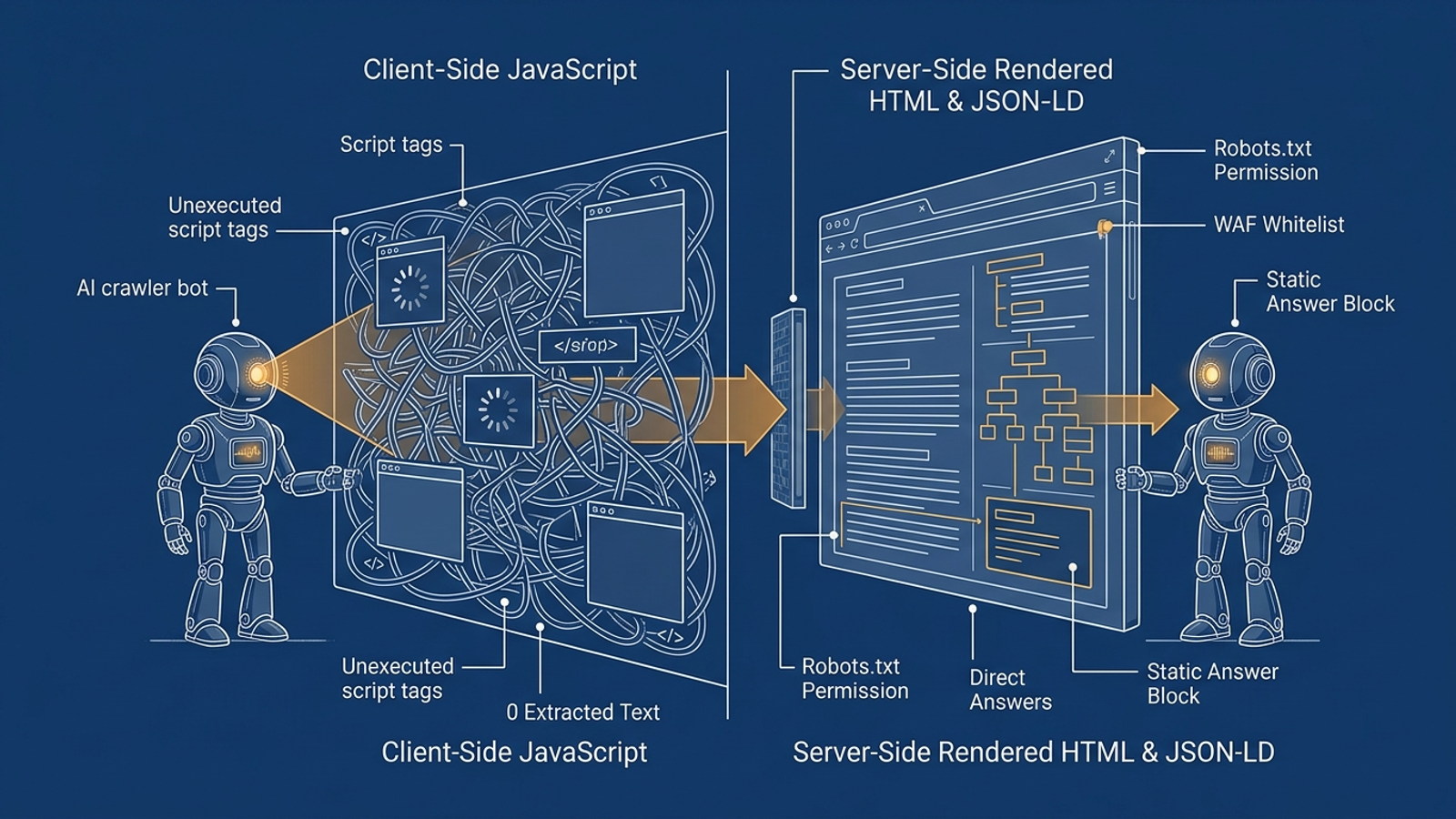
Marketers can spot a crawl problem; they usually cannot change how a site renders. If important content depends on client-side JavaScript, a bot that does not execute it may not see the answer the way a visitor does. ZipTie’s discussion of AI crawlability raises that issue for GPTBot. The useful response is to inspect the affected pages and decide what the server needs to deliver, not assume every page needs the same rebuild.
The work may involve rendering, crawl permissions, structured data where appropriate, or a web application firewall rule. It is easy to turn that list into a shopping cart of fashionable fixes. An SE Ranking study of 300,000 domains found no statistical correlation between adding an llms.txt file and AI citation frequency. A text file is not a substitute for checking whether the underlying page is accessible.
I budget 4–8 developer hours a month at $100 an hour, or $400–$800, for the fixes this program identifies. That is a modest allocation, not a promise that every issue fits into one sprint. The practical question is the one in this technical SEO fix breakdown: who can implement the change after the audit finds it?
Line 7: off-site mentions require follow-through
Your own site is not the only place an answer can draw from. Trade directories, reviews, and industry publications can supply context about a business or category. That gives off-site citation work a place in the budget, but it does not make every pitch a placement.
A dedicated PR agency is a separate spending choice: the agency pricing cited here runs $3,000–$7,500 a month. This ledger uses an in-house alternative instead. I allow 12–16 marketer hours monthly, or $566–$755, to identify relevant opportunities, prepare pitches, follow up, and keep the resulting mentions straight. Tools could add to that cost; they are not included in the total. If nobody owns the follow-up, do not budget for the outcome as though it will arrive on its own.
The hidden line: a fix that never ships
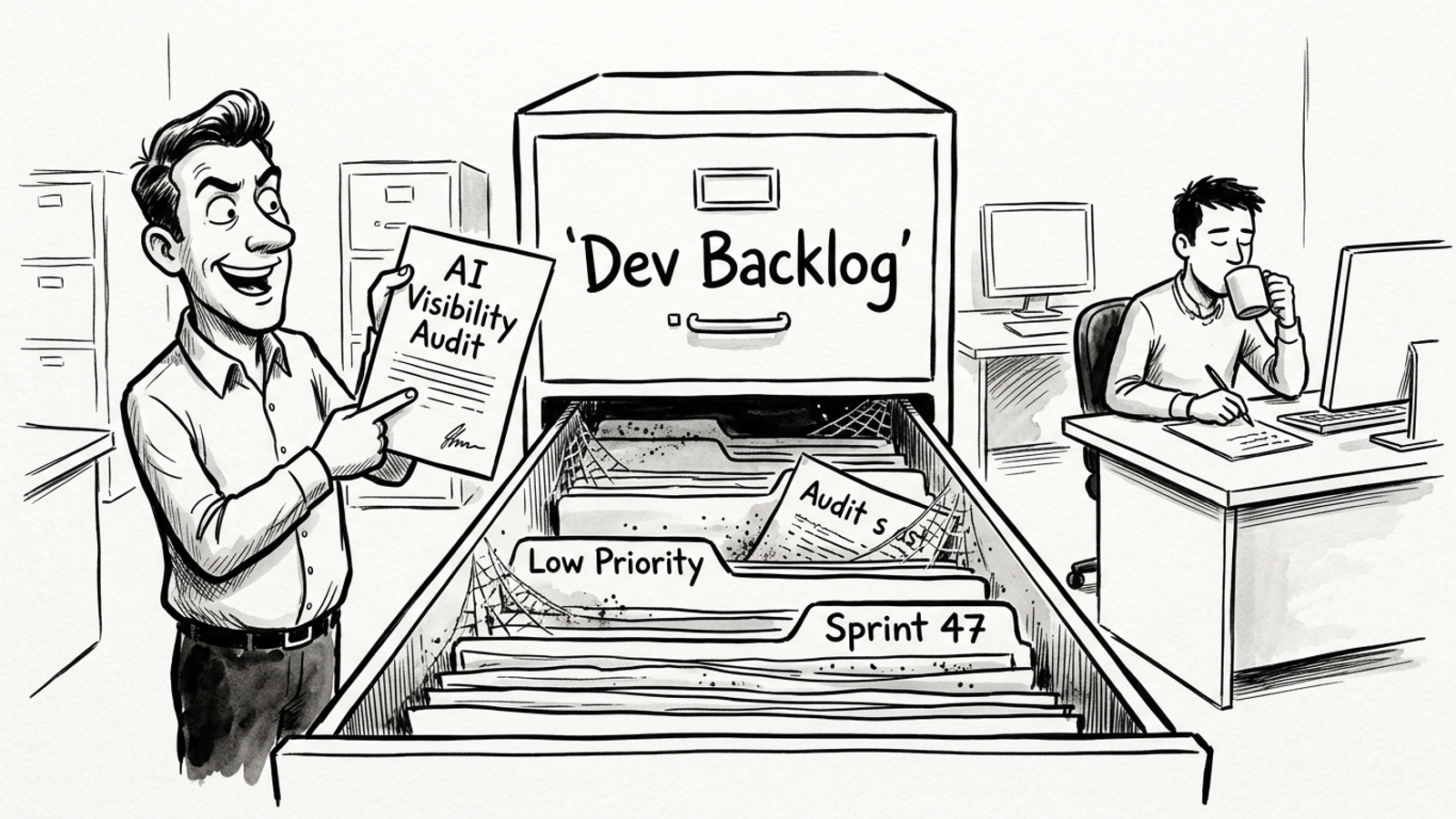
Every monthly total above assumes findings become work. That is the weak joint in the in-house plan. A marketer can log a rendering issue on Monday, explain it on Thursday, and find the ticket untouched months later because the developer has product work that customers can see immediately. The audit may be right. The fix may still go nowhere.
Technical SEO practitioners describe recommendations sitting in development backlogs. The timing will differ by company, so I would not put a universal dollar figure on missed citations or revenue. The bill you can see is enough: four months of $399 monitoring and $377 of monthly analysis add up to more than $3,100 spent continuing to inspect the same unresolved problem. That does not make those tools worthless. It makes an owner and an implementation slot part of the purchase.
Three monthly budgets, three different scopes
Here is how I would read the totals. The tiers are different amounts of work, not three prices for the same result:
- Minimal: about $970–$1,230 a month. The draft budget allows a $29–$99 monitoring plan, 8–12 combined hours for prompt upkeep and report review, one four-hour internal content refresh, and eight hours of outreach. There is no developer allocation. It buys a limited view and some activity, not a way to clear technical blockers.
- Realistic small business: $3,011–$4,655 a month. This is the table’s multi-engine monitoring, cloud crawler, regular prompt and report work, two rewrites and a new asset, 4–8 developer hours, and targeted outreach. At the working midpoint, it is about $3,833 a month.
- Serious growth: roughly $6,200–$9,500 a month. The draft’s larger scope uses $499 monitoring, $120 crawling, at least 30 marketer hours (about $1,415), $2,200–$3,500 for weekly content production with freelance support, 10–15 developer hours ($1,000–$1,500), and $1,000–$2,500 for active outreach. More output and more engineering capacity drive the increase, not a mysterious enterprise surcharge.
Do not compare the minimal tier with a full-service quote and announce you have found a bargain. Compare the tasks, then compare the invoices.
Break-even against a done-for-you service
The honest comparison starts with scope. A realistic in-house program here is about $3,833 a month at the working midpoint, plus setup time in the first month and the risk of tickets waiting for attention. If a done-for-you provider quotes a flat monthly fee, compare that fee with the work it will own: monitoring, decisions, content execution, technical implementation, and off-site activity. A cheaper quote that leaves the fixes with your already-full development team has not removed the backlog cost.
That is where groas makes a stronger case than the dashboard-first DIY approach. It pairs autonomous search execution with a named human strategist, a flat monthly fee, no setup fee, and month-to-month terms. The point is not that a service makes engineering constraints disappear. It is that continuous execution and an accountable owner address the labor and handoff problem the subscription does not. I would still ask exactly which changes can be made directly and which require your team’s approval or access. Then compare the quoted fee with the scope you would otherwise staff yourself. Without that quote, claiming a universal dollar saving would be sales arithmetic, not break-even math.
Who should still do it in-house?
I can see two clear reasons. First, a new business may have very little cash and a founder willing to spend substantial time researching prompts, writing pages, and chasing fixes. That is a cash decision, not proof the work takes no time. Second, a business with strict internal review requirements may need its own team to approve every answer and change before publication. Moving the work outside does not remove those approvals.
For everyone else, the question is not whether a marketer can learn a dashboard. It is whether the business will give that marketer production time and a route to engineering. That is also the useful test when deciding whether to run AEO in-house or hire a done-for-you partner: who owns the fix, and when can it ship?
The cheapest mistake is buying the $29 tool, leaving it untouched for two months, and cancelling after $58. The most expensive is calling the operation in-house while paying for monitoring, spending staff hours explaining the same report, and letting the change that matters sit in the development backlog. One wastes a subscription. The other keeps paying for a program that never gets out of the spreadsheet.